
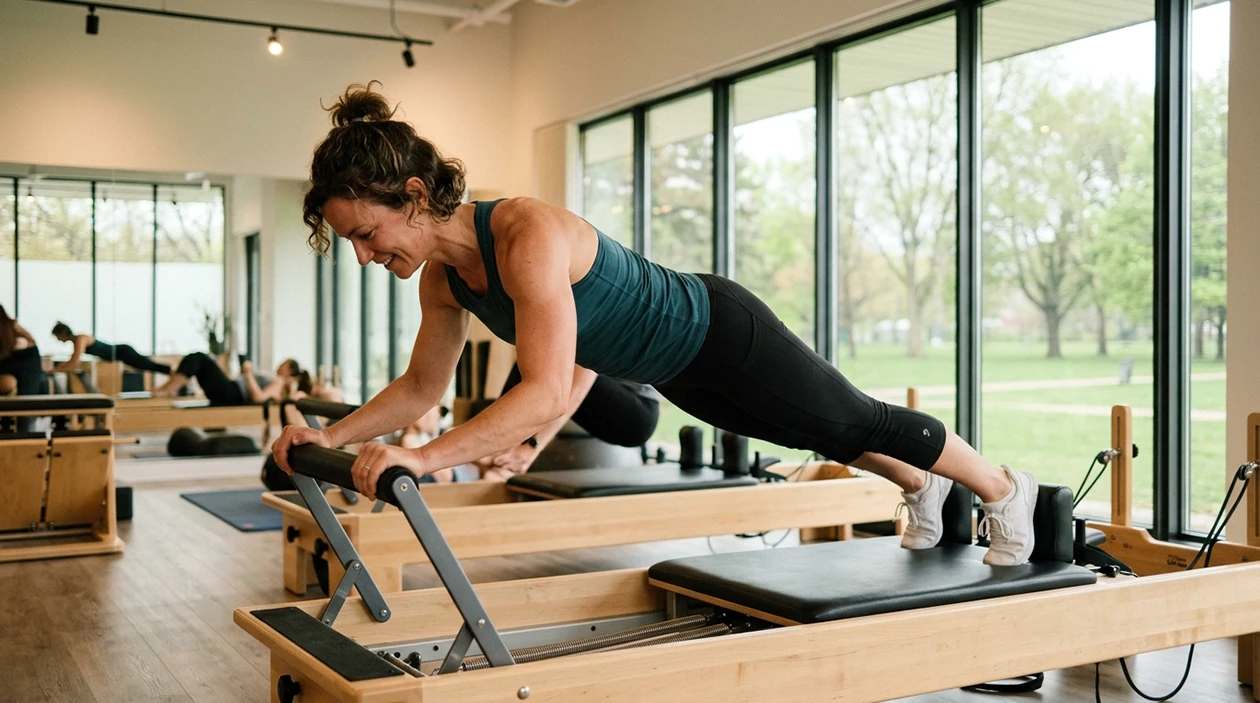
Yes. Reformer Pilates builds lean muscle through progressive spring resistance and eccentric muscle contractions. It will not create the bulky mass of heavy weightlifting, but it effectively increases muscle endurance, core strength and visible definition. To build muscle with intent, you need heavier spring tensions and a consistent rhythm of three to four sessions each week.
It is one of the most common questions we hear at SOHL Studio in Bella Vista, often from people who already love how Reformer Pilates feels but want to know whether it is genuinely reshaping their body or simply lengthening it out. The short version is that resistance is resistance. When you load a muscle against a spring and control the movement on the way back, you create the same mechanical tension that signals a muscle to adapt, repair and grow stronger. The difference is in how that load is applied, and that is exactly what this guide breaks down, including a spring-by-spring routine you can take into your next session.
Can You Actually Build Muscle from Reformer Pilates?
Quick answer: Yes, through eccentric loading and time under tension created by the springs. The reformer lets you control resistance in both directions of a movement, which is one of the most effective ways to fatigue a muscle and prompt it to rebuild.
Two mechanisms do the heavy lifting here. The first is eccentric loading, which is the lengthening phase of a movement, for example slowly bringing the carriage back in under control rather than letting the springs snap it home. Eccentric contractions place a muscle under a high degree of tension while it lengthens, and that tension is a powerful trigger for strength and muscle growth. The second is time under tension. Because reformer movements are slow, controlled and continuous, your muscles stay engaged for longer than they might during a fast, momentum-driven repetition. More quality time under load means more stimulus for adaptation.
What you build is lean, dense, fatigue-resistant muscle rather than maximal size. If your goal is the largest possible muscle mass, heavy barbell training will always have the edge, and we explain why in the comparison further down. For most people who want to feel strong, move well and look defined, progressive reformer work delivers exactly that.
The Muscle-Building Reformer Routine
Here is a simple structure you can request or work towards across a few sessions. It targets the lower body, upper body and core with enough resistance to drive adaptation. Spring tensions use the common red and blue colour convention, where red is a heavier spring and blue is lighter. Spring colours vary between studios and equipment brands, so if your studio uses a different system, ask your instructor for the equivalent tension.
| Focus | Exercise | Springs | Sets and reps |
|---|---|---|---|
| Lower body | Reformer Lunges | 1 Red, 1 Blue | 3 sets of 10 |
| Upper body | Kneeling Arm Series / Chest Expansion | 1 Blue or 1 Red | 3 sets of 12 |
| Core | Pikes / Jackrabbits | 1 Red | 3 sets of 15 |
Work the eccentric phase of every repetition slowly, taking around three seconds to return the carriage to the start. That control is where the muscle-building happens. Rest for 45 to 60 seconds between sets, and only add resistance once you can complete every repetition with clean form.
Try This Now: At your next class, ask your instructor to upgrade your spring tension by one level, for example from blue to red, during the footwork series. Footwork is a safe, stable place to test heavier load because your spine is fully supported. If your form holds and the final few repetitions feel genuinely challenging, you have found your new working tension.
What Progress Looks Like (Weeks 1 to 12)
Muscle adaptation follows a fairly predictable timeline. Here is what to look for so you know it is working.
| Timeframe | What is happening | What you will notice |
|---|---|---|
| Weeks 1 to 2 | Neuromuscular adaptation | Better balance and coordination; movements start to feel less awkward |
| Weeks 4 to 6 | Increased strength | You can add spring tension and complete more controlled repetitions |
| Weeks 8 to 12 | Visible change | Muscle definition and body-shape changes become noticeable |
If your main goal is changing how your body looks rather than how it performs, our guide on whether Pilates can transform your body shape goes deeper on that side of things.
Which Is Better, the Gym or Reformer Pilates?
Quick answer: The gym wins for absolute strength and large muscle size, or bulking. Reformer Pilates wins for core stability, mobility, posture and lean muscle endurance. Neither is better in every sense. The right choice depends on what you actually want your body to do.
| Goal | Gym / Weightlifting | Reformer Pilates |
|---|---|---|
| Muscle size (hypertrophy) | ★★★★★ | ★★★ |
| Core and pelvic floor strength | ★★ | ★★★★★ |
| Posture correction | ★★ | ★★★★★ |
| Lowering stress hormones (cortisol) | ★★ | ★★★★ |
Which One Should You Choose?
- If you want to lift as heavy as possible or build noticeably larger glutes, the gym is your priority.
- If you want a strong centre, better posture and lean, defined tone, choose Reformer Pilates.
- If you want both, a hybrid week works beautifully: two gym sessions for raw strength and two reformer sessions for control, mobility and core.
At SOHL Studio our SOHL Strong sessions are built around exactly this kind of progressive, resistance-led work, while SOHL Flow blends sculpting and core intensity in a single session. You can see the full range on our Reformer Pilates classes page.
Does Pilates Help With High Cortisol and Cortisol Belly?
Cortisol is your body’s main stress hormone. It is completely normal and necessary, but when it stays elevated for long periods, often through chronic stress, poor sleep or relentless high-intensity training, some people find it harder to lose fat around the midsection. This is the pattern often referred to as cortisol belly. It is worth saying up front that belly fat is influenced by many things, including genetics, sleep, nutrition and overall stress, so cortisol is only ever part of the picture.
Three Signs Your Training May Be Raising Your Cortisol
Some people who are overtraining notice a recognisable pattern. You might relate to it if you are:
- Holding onto belly fat despite doing plenty of intense cardio
- Feeling wiped out and unusually fatigued an hour or two after a hard session
- Struggling with disrupted or poor-quality sleep
If these sound familiar and they persist, it is worth speaking with your GP, since ongoing fatigue and sleep issues can have many causes that are worth ruling out.
Here is where low-impact movement helps. Punishing, high-intensity sessions can keep the stress response switched on. Reformer Pilates works differently. It is moderate in intensity, controlled and breath-led, and research into mind-body movement suggests this style of exercise can help bring the stress response back towards balance rather than ramping it up. You still get real mechanical tension on the muscles, which supports strength and fat loss, but without the constant cortisol spike that can come from always redlining. In other words, you can train hard enough to see change while still letting your nervous system settle.
A Balanced Weekly Schedule
If you suspect stress and recovery are working against you, a varied week lets you keep training without overloading your system. Here is an example built around our class styles.
| Day | Session | Focus |
|---|---|---|
| Monday | Reformer, strength focus | Heavier springs and progressive load (think SOHL Strong) |
| Wednesday | Reformer, flow and stretch | Lighter springs, mobility and release (think SOHL Recovery) |
| Friday | Reformer | Moderate, low-impact cardio |
| Weekend | Walking | Active recovery and gentle movement |
Three quality reformer sessions a week, spaced to allow recovery, is plenty for most people chasing strength and body-composition change. For more on finding your ideal frequency, see our guide on how many times a week you should do Pilates.
Why Does My Back Hurt After Reformer Pilates? (And Who Should Take Care)
Quick answer: Back soreness after Reformer Pilates usually comes from dumping into your lower back instead of engaging your deep core, or from using springs that are too heavy for your current core strength. In most cases it is a technique issue, not a sign that reformer work is bad for your back.
Your deep core, particularly the transverse abdominis, is meant to act like an internal corset that stabilises your spine during every movement. When that deep layer is not switched on, your lower back muscles try to take over the job, and they fatigue and ache as a result. The fix is rarely to stop. It is to reconnect with the right muscles and to match your spring load to your current strength. Our guide to using Pilates for core strength explains how to build that deep stability.
Common Mistakes and Easy Fixes
| Mistake | The fix |
|---|---|
| Arching your back during leg extensions | Imprint your spine gently into the carriage and keep your legs higher, around a 45 degree angle, until your core is stronger |
| Gripping and tensing your neck during the hundred | Rest your head down on the carriage and let your core do the work, not your neck and shoulders |
| Loading springs that are too heavy too soon | Drop down a spring level and earn the heavier tension once your form holds |
Who Should Take Extra Care
Reformer Pilates is genuinely low impact and suitable for most people, including those returning from injury. That said, if you are managing an acute injury, a recent surgery, a high-risk pregnancy or a diagnosed back condition, get clearance from your doctor or physiotherapist first, and start with one-on-one guidance rather than a group setting. This is exactly what our semi-private and clinical sessions are designed for, with a one-on-one initial assessment so your program is matched to your body. You can also read more in our guide to Pilates for back pain.
Build Real Strength at SOHL Studio
Reformer Pilates absolutely builds muscle when you train with intent: progressive spring tension, slow eccentric control and three to four consistent sessions a week. Do that, and lean strength, better posture and visible definition follow.
At SOHL Studio in Bella Vista, every reformer session is capped at six people and led by diploma-trained instructors, so your technique and your spring load are actually watched and adjusted.
Ready to feel the difference progressive resistance makes? Our $99 intro offer gives you 14 days of unlimited Reformer Pilates to put it to the test.
Book a class or get started today by calling 0450 153 453, or book online through our timetable.
