
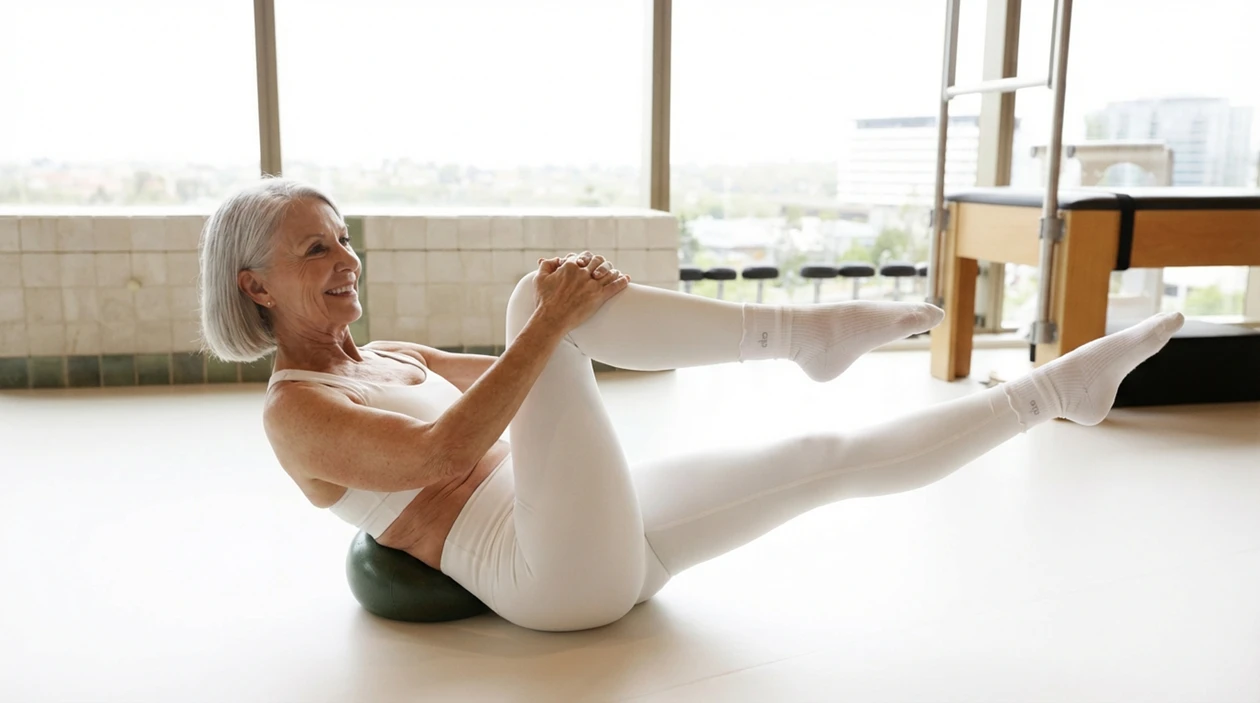
You’ve probably heard that Pilates is good for you. But at 70-plus, you’re not interested in what’s “good”, you want to know what’s safe.
Fair enough. Let’s get straight to it.
Is Pilates Actually Safe for Seniors Over 70?
Yes. Pilates is excellent for older Australians because it’s low-impact and performed mostly lying down or seated. That means less stress on your joints and a dramatically lower fall risk compared to standing exercises.
Unlike high-intensity workouts that spike your heart rate and blood pressure, Pilates focuses on controlled, deliberate movements. You’re building strength from the inside out—not pushing your body to breaking point.
But “generally safe” doesn’t mean “right for everyone.” Before you start, run through this quick self-assessment.
Your “Green Light” Checklist
Answer these honestly:
Can you get down to the floor and back up again (even slowly)?
If yes, you’re cleared for mat Pilates. If no, start with Chair Pilates instead—same benefits, no floor work required.
Have you had spinal surgery in the past 12 months?
If yes, get clearance from your specialist before starting. Some movements involve spinal flexion that may not be appropriate during your recovery window.
Do you have severe osteoporosis?
If yes, avoid exercises that involve forward flexion (bending forward at the spine). Stick to extension-based movements and consult your GP or physio first.
The Honest Downsides
Pilates isn’t magic. Here’s what it won’t do:
It requires consistency. Sporadic sessions won’t deliver results. You need to show up at least three times a week to see meaningful changes.
Poor form can aggravate existing back pain. This isn’t unique to Pilates—any exercise done incorrectly causes problems. That’s why we’ve included detailed technique notes for every exercise below.
Now that you know you’re cleared to start, let’s get into exactly what you need to do.
The Only 5 Exercises You Need
Forget complicated routines with 20 different moves. For seniors, simplicity wins. These five exercises cover everything: core strength, spinal mobility, posture correction, and balance.
Do these three times a week and you’ll notice the difference within a month.
Exercise 1: The Pelvic Tilt (Your Foundation)
This is the “Number One” exercise for seniors—and for good reason. The pelvic tilt teaches you how to engage your deep core muscles, which support your lower back in everything from walking to getting out of a chair.
Every other Pilates exercise builds on this foundation. Master it first.
Try It Now
Step-by-step:
- Lie on your back with knees bent, feet flat on the floor hip-width apart, arms relaxed by your sides.
- Breathe in to prepare. As you breathe out, gently draw your belly button toward your spine and press your lower back into the floor—your pelvis will naturally tilt upward.
- Hold for 3 seconds, then release and return to neutral. Repeat 10 times.
The Senior Modification:
If lying flat causes discomfort in your neck or upper back, place a folded towel or small pillow under your head. This keeps your spine in better alignment without straining.
Common Mistake:
Don’t hold your breath. The breathing is the exercise. Exhale as you tilt, inhale as you release. If you’re turning red or feeling strain in your face, you’re working too hard.
Exercise 2: The Dead Bug (Modified for Seniors)
The name sounds morbid, but this exercise is brilliant for building core stability without crunching or straining. The standard version can be too challenging for beginners, so we’ve modified it specifically for older bodies.
This strengthens the muscles that prevent your lower back from arching when you move your arms and legs—essential for everyday activities like reaching into cupboards or bending to pick something up.
Try It Now
Step-by-step:
- Lie on your back with knees bent and feet flat on the floor (same starting position as the pelvic tilt).
- Lift one leg so your knee is directly above your hip and your shin is parallel to the ceiling—like you’re resting your calf on a coffee table.
- Keeping your lower back pressed gently into the floor, slowly lower that foot back down. Repeat 8 times, then switch legs.
The Senior Modification:
If lifting your leg feels too intense, start by simply sliding your heel along the floor away from you, then sliding it back. This reduces the load on your core while still teaching the movement pattern.
Common Mistake:
Allowing your lower back to arch off the floor as you move your leg. If you notice a gap appearing between your back and the mat, you’ve gone too far. Reduce the range of movement until you can maintain contact.
Exercise 3: The Bridge (Glute and Spine Strength)
Weak glutes are one of the biggest contributors to lower back pain and poor balance in seniors. The bridge strengthens your backside while gently mobilising each vertebra of your spine—a two-for-one benefit you can’t afford to skip.
Try It Now
Step-by-step:
- Start lying on your back, knees bent, feet flat and hip-width apart. Arms rest by your sides with palms down.
- Exhale and press through your heels to lift your hips toward the ceiling, peeling your spine off the mat one vertebra at a time until you form a straight line from shoulders to knees.
- Pause at the top for a breath, then slowly lower back down, placing each vertebra onto the mat from top to bottom. Repeat 8-10 times.
The Senior Modification:
If your hamstrings cramp (common when glutes are weak), bring your feet slightly closer to your bottom. If you struggle to lift high, don’t worry—lift only as far as comfortable and focus on the peeling motion rather than height.
Common Mistake:
Pushing your hips too high and arching your lower back. You should finish in a straight diagonal line, not a dramatic arch. Think “long spine” rather than “high hips.”
Exercise 4: The Swan Prep (Posture Correction)
Years of sitting, driving, and screen time create forward-hunched posture. The Swan Prep is a gentle back extension that counteracts this rounding, opening your chest and strengthening the muscles between your shoulder blades.
This is particularly important for breathing—rounded posture compresses your lungs and makes it harder to take full breaths.
Try It Now
Step-by-step:
- Lie face-down on the mat with your forehead resting on your hands (stacked, palms down). Legs are straight and relaxed.
- Keeping your hip bones pressed into the mat, inhale and gently lift your head and chest a few centimetres off the floor. Imagine a string pulling the crown of your head forward and up.
- Hold for 2 seconds, exhale and lower back down. Repeat 6-8 times.
The Senior Modification:
If this position bothers your lower back, place a small folded towel under your hips/pelvis for support. If your neck feels strained, keep your forehead hovering just above your hands rather than lifting your gaze.
Common Mistake:
Using momentum or pushing up with your hands. The lift should come entirely from your back muscles. Your hands are just a resting place—they shouldn’t be doing any work.
Exercise 5: Side-Lying Leg Lifts (Hip Stability and Balance)
Balance isn’t just about standing on one leg, it’s about hip strength. Your hip abductors (the muscles on the outside of your hips) are critical stabilisers that prevent falls. This exercise targets them directly.
Try It Now
Step-by-step:
- Lie on your side with your bottom arm extended under your head (like a pillow). Stack your hips directly on top of each other and bend your bottom leg slightly for stability.
- Keeping your top leg straight and in line with your body (not forward), exhale and lift it toward the ceiling—about 30-40cm is plenty.
- Lower with control. Repeat 10-12 times, then roll over and repeat on the other side.
The Senior Modification:
If balancing on your side is difficult, lie with your back against a wall for support. You can also bend both knees and do a “clam shell” movement instead—same muscle group, less challenging position.
Common Mistake:
Rotating your leg outward so your toes point to the ceiling. Your toes should point forward or slightly down throughout. The rotation engages different muscles and reduces the effectiveness.
Pilates vs Yoga: Which Should You Choose?
If you’re weighing up Pilates against Yoga, here’s the short answer: choose Pilates if core strength, injury recovery, or spinal stability are your priorities; choose Yoga if flexibility and relaxation matter most. Both are excellent for seniors, and in an ideal world you’d do both. But if you’re picking one, Pilates typically delivers better results for functional strength and fall prevention—the things that matter most as we age. For a detailed breakdown of how the two compare on balance, posture, difficulty, and body composition, read our full guide: Pilates vs Yoga: Which Is Better for You?
How Often Should Seniors You Do Pilates?
For seniors, three 20-minute sessions per week hits the sweet spot, enough to build strength and see results, without overdoing it. Pair this with five minutes of daily walking and one rest day for gentle stretching. As Joseph Pilates famously said, “In 10 sessions you feel the difference, in 20 you see the difference, and in 30 you have a whole new body.” Most seniors notice improved body awareness and less stiffness within the first few weeks, with visible posture changes following by week four to six. For a complete breakdown of training frequency, realistic timelines, and what to expect at each stage, read our full guide: How Many Times a Week Should You Do Pilates?
Troubleshooting: The 3 Most Common Mistakes
Mistake 1: Straining Your Neck
The Problem: Your neck feels tight or sore during or after exercises, particularly the pelvic tilt or dead bug.
The Solution: Keep your head down on the mat. Many beginners instinctively lift their head to “watch” what they’re doing—this creates unnecessary neck tension. Use a small cushion under your head if lying flat is uncomfortable. Trust that you’re doing it right without needing to see.
Mistake 2: Holding Your Breath
The Problem: You’re concentrating so hard on the movement that you forget to breathe. You finish a set feeling lightheaded or with your face flushed.
The Solution: Make breathing your primary focus. The rule is simple: exhale on the exertion (the hard part), inhale on the release. If you can’t talk during an exercise, you’re holding your breath. Slow down and prioritise breath over movement.
Mistake 3: “Pushing Through Pain”
The Problem: You feel discomfort but continue the exercise because you think it’s supposed to be hard.
The Solution: Adopt the “No Pain” rule. At 70-plus, pain is information—not weakness. Sharp pain, joint pain, or nerve pain means stop immediately. Muscle fatigue (a gentle burning sensation in the working muscles) is acceptable. Everything else is your body telling you something is wrong.
Ready to Give Senior Pilates a Try?
You’ve got the exercises, you understand the benefits, and you know what to expect. Now it’s about taking that first step—and you don’t have to do it alone.
At SOHL Studio, we specialise in helping seniors build strength, improve balance, and move with confidence. Whether you’re completely new to Pilates or returning after years away, our experienced instructors will guide you through every movement at your own pace.
No intimidating group classes. No pressure to keep up. Just supportive, personalised instruction designed for bodies over 70.
Contact SOHL Studio today to book your first session or ask any questions. We’d love to help you feel stronger, steadier, and more confident in your body.
